

12-4-18
In a rare opportunity the artist David Bowie was able to leave fans one last gift…though it may be wrapped up in grief and death, it’s creation alone signifies a hope that many do not get to give. In his final year leading up to his death Bowie knew his time was waning, and so as he did so many times before he allowed his life to act as the canvas for which he would make his final creation.
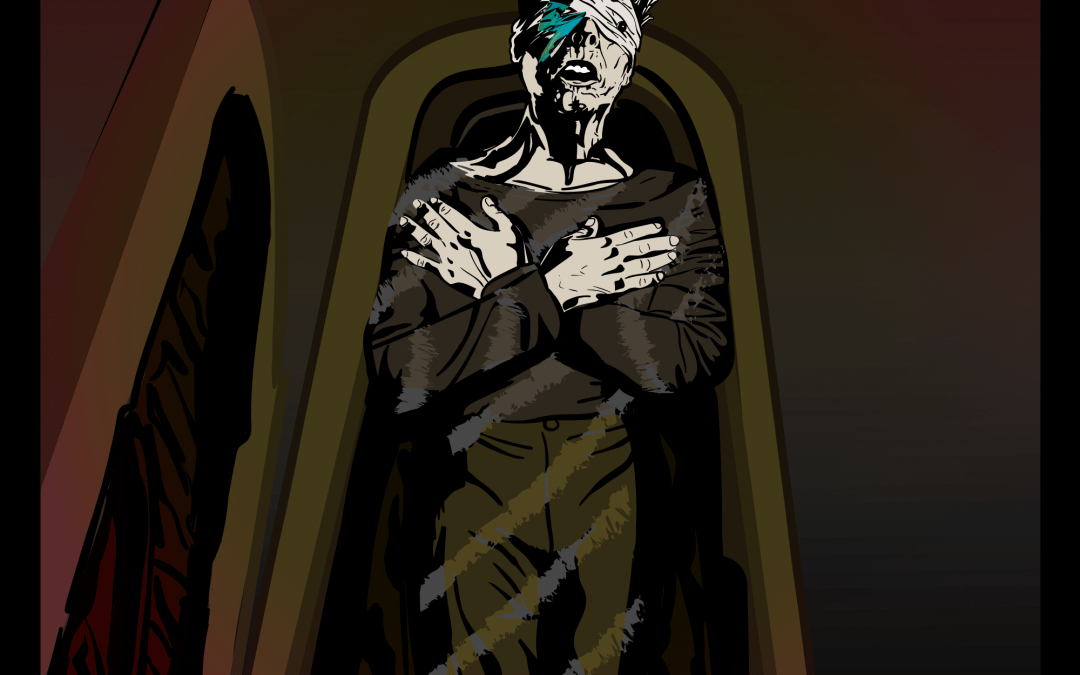
Using the symbolism of Lazarus of Bethany, the man which Jesus brought back from the dead four days later, Bowie attempted to draw parallels with his own chronic illness which was quickly taking the artist’s life day by day. From the video to the lyrics, Lazarus can be seen as a person’s struggle with the inevitable, as well as farewell letter.
Dying is one of the few things that ties every person together. It’s inescapable, and most of us have no one in knowing when our time comes. In Bowie’s case, he had a little more insight. Instead of pining away in regret and remorse he decided to leave the world with one last series of messages. An individual’s battle with ego, regret, and remorse. However, these themes aren’t presented in the way that one may assume. There’s a balance to his exploration. In every negative element that is presented it is approached with some element of strength by its side. Leave it to David to play with the concept of duality even in his death.
Going through Blackstar, Bowie’s final album, it’s hard to tell if the album was more for him or the fans. The lyrics and songs are highly reflective, touching on most eras of his life, and rarely in a rose-tinted way. His honesty is something fans have grown accustomed to over his 40+ years of making music. This last album was his opus to that testament.
It’s hard not to hear a person grieving for their own end throughout the album. In one verse he may be courageously anticipating his death, in others he shows signs of frustration, not because death is final, but because he won’t be able to share everything he has left. As someone who likes to consider themselves an artist I can’t help and sit in awe of this sentiment. Instead of giving up and giving in, using the threat of finality to push yourself to continue creating so you’re able to leave more or less on your own terms… well that’s pretty much most people’s dreams.
He realized his impact on this world. I don’t think that’s egotistical or arrogant, it’s just a matter of fact. Generations of kids grew up seeing this person normalize everything they were told to subdue. It was ok to be the weird person within, Bowie made it cool. This impact has reverberated more than anyone can understand, and I think in part, it’s because of that impact he felt compelled to leave a proverbial letter to his listeners. He knew we’d be grieving his passing, maybe this album was intended to help us with that.
I never really knew how much this person impacted my life until they were gone. Even to this day I can easily begin to mourn his passing nearly three years later. He grew into what many aspire to be, a symbol. His art, and his life were rarely separated and because of this fact he was always a highly vocal advocate for numerous issues that impacted the world at large. I must have heard David Bowie for the first time when I was 5 or 6, I remember the Life on Mars, album cover, seeing this person with crazy hair, crazy makeup… honestly, he looked like a superhero to me. I suppose that image of him never really went away.
Lyrics:
Look up here, I’m in heaven
I’ve got scars that can’t be seen
I’ve got drama, can’t be stolen
Everybody knows me now
Look up here, man, I’m in danger
I’ve got nothing left to lose
I’m so high it makes my brain whirl
Dropped my cell phone down below
Ain’t that just like me
By the time I got to New York
I was living like a king
Then I used up all my money
I was looking for your ass
This way or no way
You know, I’ll be free
Just like that bluebird
Now ain’t that just like me
Oh I’ll be free
Just like that bluebird
Oh I’ll be free
Ain’t that just like me